The Oxford English Dictionary (OED) wasn't constructed in isolation. James Murray and his team's opus drew heavily upon, and finally replaced, Dr Johnson's Dictionary.
It took 70 years to produce the first edition of the OED, as I discussed in my last post. But that's only part of the tale.
"In this lively and erudite survey, Hitchings embraces the vitality of Johnson's language, unravelling roots and meanings with energy and enthusiasm ... [urging] the reader ... to re-engage with the vitality of the English language." Gemma Read (Observer)
History is only one facet of the story. There's plenty to read and read about when it comes to the OED.
For example, last year, I came upon Ammon Shea's Reading the OED: One Man, One Year, 21,730 Pages, a magnificent tale of worsening eyesight and dictionary-reading. Letter by letter, we're treated to a summary of Shea's reading experience along with some of the best words the letter has to offer. A logolept's (diary par extraordinaire. At less than 250 pages, this great read was too short to my taste.
"[O]nly a man who lives and breathes dictionaries could have completed the task ... [and s]omewhere near the word 'avenge' he experienced ... proof that spending ten hours a day squinting at a dictionary is unhealthy when his vision turned grey for several hours. ... [A] tale of physical deterioration, endless cups of coffee and emotional disintegration." Ben Hoyle (The Sunday Times)
"Mugglestone describes the chance discovery that motivated her to write Lost for Words: innumerable proof sheets, ... letters and other archival resources [at the Oxford University Press and Bodleian Library]. Mugglestone imparts particularly well the endless controversy over the dictionary's scope versus time constraints." Katherine Bailey (HistoryNet)
There's more to dictionaries than meets the eye. You can read them, read about them, and learn about the logistics making them readable.
♥ ♥ ♥Reading the OED: One Man, One Year, 21,730 Pages. This is dedication. Entire days spent at home and in the New York Public Library. Shea read the books, not an on-line version. Take one look yourself, and you'll understand why he began having eyesight problems: a variety of typefaces, myriad abbreviations, Greek, and more. It gave me the urge to read a dictionary, but something way smaller.
Some people consult dictionaries, others read them, while many do both. I belong to the last group and my word book de préférence is the Oxford English Dictionary (OED).
"Winchester['s] elegant and scrupulous retelling [of ] The Professor and the Madman, proves ... to be more complicated [and] stranger ... than the yarn that preceded it. ...[T]here is also a cruel irony in the fact that today's ... treatment and drug therapy might have removed [Dr Minor's] symptoms." David Walton (New York Times)
After reading the sad tale of Dr WC Minor one of the Dictionary's most prolific volunteers, I moved on to its context, The Meaning of Everything: The Story of the Oxford English Dictionary. I'd never thought of the OED as special before reading its history, but now I have an inkling into why I prefer this attempt at all-inclusiveness to the competition.
"[The Meaning of Everything] is a fascinating history. ... [Winchester] is particularly entertaining when describing the vast and quirky brigade of unpaid readers who supplied the material for the dictionary's famous 'slips'. ...[A] more recondite but equally pleasurable account of the dictionary itself." Andrew Rosenheim (Independent)
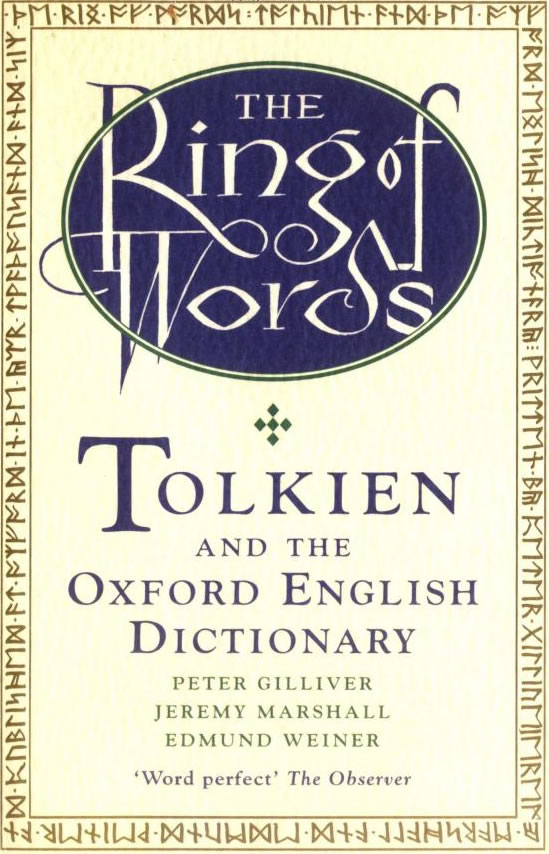
Once I discovered The Ring of Words: Tolkien and the Oxford English Dictionary was about to be published, I set about inviting one into my home. I still find the concept of an entirely invented language, words, grammar, syntax -- the works, amazing. The idea that Tolkien began as a small child is mind-boggling.
"[The authors] are in a perfect position [being] among the current editors of the dictionary ... [A] book that is effortless to read, appealing to the layman as much as an academic. I would happily reccomend this book." (tolkeinlibrary.com)
"Drawing on both family papers and the archives of the OED, [the book] is a sensitive, perceptive appraisal, showing the complicated interrelationships of institutions and personalities." Raven I McDavid, Jr (Modern Philology, Vol 77, No 4)
James Murray and his team worked in the "Scriptorium", a too-small, damp structure purpose-built in his back yard. And you had always imagined dictionaries were created in the refined and rarefied air of an exclusively small number of ivory towers.
In June 2009, Texas-based Global Language Monitor (GLM)¹ announced that "Web 2.0" was English's millionth word (or, more correctly, term).
"Currently there is a new word created every 98 minutes or about 14.7 words per day. ... [T]he recent Google/Harvard Study of the Current Number of Words in the English Language is 1,022,000. The number of words in the English language according to GLM now stands at: 1,008,879..." The Global Language Monitor (3 Feb 2011).
Some people cheer at these sorts of announcements, while others shake their heads in derision, insisting upon the impossibility of such a tally. So, how did they do it? Take the most up-to-date dictionary and add all the new words not yet included?
Reasonable, right?
Absolutely not, and the reasons why can be found in Jack Lynch's recent book,The Lexicographer's Dilemma. I came across it at the Main Branch of the New York Public Library's bookstore, home of some of the only books you can remove from this non-lending library. Let this Associate Professor of English at New Jersey's Rutgers University, treat you to a whirlwind tour of just what constitutes a dictionary entry -- a word (term), in other words -- and how it qualifies for inclusion in a standard dictionary.
To start, the lexicographer must make some basic decisions: What kinds of terms will the dictionary include? When does a word become archaic? Obsolete? Should I include them? What makes a new coinage stick worthy of recognition? What about nonce words?
We also learn that a so-called all-inclusive dictionary is really only a subset of the tongue. Technical terms (eg, chemicals) exist for both known and theoreticalcompounds, yet the only ones you'll find will be those in common use. For the rest, consult an all-inclusive specialized dictionary. Note however, there some omissions always remain.
Prefixes and suffixes present another dilemma. Take "un-" and its cognates. They can be attached to almost any noun, verb, adjective and adverb -- the list is virtually infinite. So what does the lexicographer do? Include the prefixes and suffixes themselves and their common children. Leave it up to the reader to put the rest together, says Lynch.
But Dilemma goes further than describing the mysteries of dictionary compilation, it also discusses the rise and continued fascination with the concept of "proper" English. For example, while the French, Italians and Spanish, among others, each have an official body (eg, France's Académie française) to rule upon what is proper, English has always been laissez-faire. Says Lynch:
"There are at least three reasons for the failure [to set up an Academy], the first of which is specific to English. The world's English-speakingcountries, with their long tradition of favoring individual liberty, have never supported the kind of absolutist, top-down government that linguistic regulation seems to require. Britain, the United States, Ireland, Canada, Australia, New Zealand -- all distrust centralized regulation." (The Lexicographer's Dilemma)
Some people recognize Canadian English
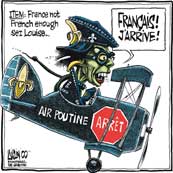
Our author has slipped up on Canada: The QOLF (OQLF in French) aka Quebec's Language Cops routinely castigates France2 on it's improper use of its language and others'. One commission of the QOLF, determines the correct language of place-names, resulting in changes to the spelling of the names of many cities, towns and villages (eg, the former St-Sauveur is now Saint-Sauveur). The names of hundreds of streets have adjusted along with alterations to their spelling (eg, Longueuil's Lafayette Blvd sometimes appears on signs as "La Fayette". This commission also issues pronouncements regarding the English language, for example, it forbids the phrases "in Quebec City", "in Quebec" and "in the city of Quebec" stating that the only "in the city of Québec" is correct. So,it's back to school for the lot of you!
* * *
Noah Webster3was perhaps the most successful person to impose his will upon the tongue, using his new dictionary to differentiate his new nation's speech from that of the old. Choosing one pronunciation among several for the letter "Z" and dropping the "u" from words such as "colour" and "honour" are among the most famous.
Anyone with an interest in dictionaries and the evolution of modern English will derive much enjoyment from The Lexicographer's Dilemma. (lol -- I did.)
* * *
Murray wanted the entire English language included. Courtesy simonwinchester
While many Americans may not be familiar with the OED, as a Canadian, an abridged version has always been my intimate, both on the bookshelf and at school. I procured my own copy of the Concise Oxford Dictionary from an early pay cheque. Now in itseleventh edition, the current hardcover version is 1728 pages long and includes over 240,000 entries; mine pre-dates the second edition of the full OEDand ends at page 1566. The next full edition, nicknamed OED3, is under way.
The Meaning of Everything: The Story of the Oxford English Dictionary is also the story of Professor James Augustus Henry Murray4, a self-taught polyglot Scot. A man with little formal education, he spent close to 50 years leading the production of the first edition. Nobody had any inkling of the actual time (70 years!) and cost involved (it has never turned a profit) when Murray was hired, but the results were beyond everyone's wildest dreams. If you don't love the OED before you read Winchester's book, you should after. I've read, not just consulted the dictionary since childhood, and let's just say, Winchester made me feel vindicated.
However, the task facing Murray and his team was impossible without the help of hundreds of volunteers. Working from home or elsewhere, and using the materials Murrayet al provided, they produced the famous "slips"; the raw material of the dictionary's entries. The sub-editors verified and completed the entry information.
Paul Martin of BBC2's Antiques Roadshow wannabe Flog It investigates the story of theOED[possibly the 1 Nov 2010 episode of Flog It] and sees some of Minor's "slips":
And what a sub-editor! As a small child, Tolkien was unusual. He invented his own languages. Not just words -- languages with entire grammars. So, although most of us know him as a novelist, he was primarily a philologistand professor. Specializing in Anglo-Saxon and the rest of the Germanic language family, his legacy within the OED lies within the letter "W".
Histories of a variety of Tolkien's own words can be found at the end of the book. These provide fascinating insight into neologisms initially developed for his stories, some of which have become commonplace in the realm of fantasy writing and gaming.
As a novelist, when JRR employed fantasy tongues -- he wasn't just using individual words; he was using entire fantasy languages. An intriguing tale of an unusual ability, and for lovers of The Hobbit, The Lord of the Rings series, and Tolkien's other works, consider The Ring as the ultimate prequel.
Johnson's work was THE tome to consult for 150 years or so, until it was surpassed in 1928 by the OED's first edition. Johnson is still available in print, and abridged editions abound. If you're looking to pick up an original version, be prepared to pay for the nose -- Johnson remains popular. The English poet TS Eliot praised Johnsonand the erudite American literary critic Harold Bloom, author of The Western Canon: The Books and School of the Ages includes his works in the canon.
"What makes the dictionary so unique -- if not eccentric -- are Johnson's personal definitions. He was a man of many peeves and freely notes his disapproval when a word offends him ..." Matthew Price (Boston Globe, 27 Nov 2005)
One of many abridged editions is Johnson's Dictionary: A Modern Selection (Dover). From abbey-lubber (a lazy person living under false pretenses in a religious house) to zootomy (animal dissection), it's 465 pages of definitions and illustratory passages (many written by Johnson himself). Included, of course, is the term "excise", an inclusion that landed the author in court. Who won? Hint: Judges don't like paying taxes either.
* * *
Notes
¹ According to BBC News (10 Jun 2009), once GLM finds a word on the Internet 25,000 times, it is recognized as a neologism. "Web 2.0" won over Slumdog Millionaire's song "Jai Ho" and "slumdog" as well as the gaming "n00b", a derogatory term meaning neophyte.
2Montreal Gazette political cartoonist Aislin's take on his government's in meddling overseas.
3The staid Noah Webster was not a fan of the sometimes flippant Samuel Johnson (discussed elsewhere in this post).
4Should you be interested in reading more about Murray, try his granddaughter, KM Elizabeth Murray's excellent biography, Caught in the Web of Words: James Murray and the Oxford English Dictionary. My paperback weighs in at a satisfying 386 pages, and while there is no photo plate section in the centre, there are plenty of pictures throughout.